AI Marketing Leadership Transformation: From CMO to Change Management Officer in 2025
 By Ajendra Singh Thakur
Updated July 2025
9 min read
By Ajendra Singh Thakur
Updated July 2025
9 min read
Introduction
AI marketing leadership transformation is reshaping executive roles across enterprise organizations in 2025. Chief Marketing Officers are evolving into Change Management Officers as AI revolutionizes marketing strategy, operations, and business outcomes.
Based on Google’s comprehensive research with leading CMOs worldwide, early adopters of AI marketing leadership transformation gain significant competitive advantages while traditional marketing executives face organizational obsolescence.
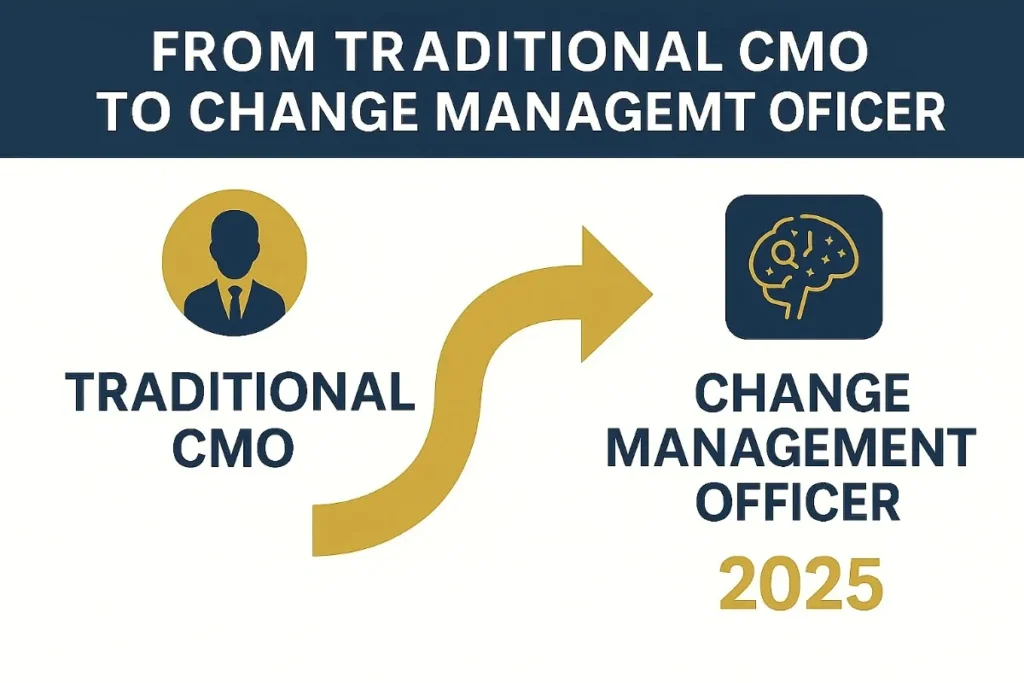
This guide provides strategic frameworks and practical implementation steps for successful AI marketing leadership transformation in enterprise environments.
Why AI Marketing Leadership Transformation is Critical in 2025
The Data Behind Executive Role Evolution
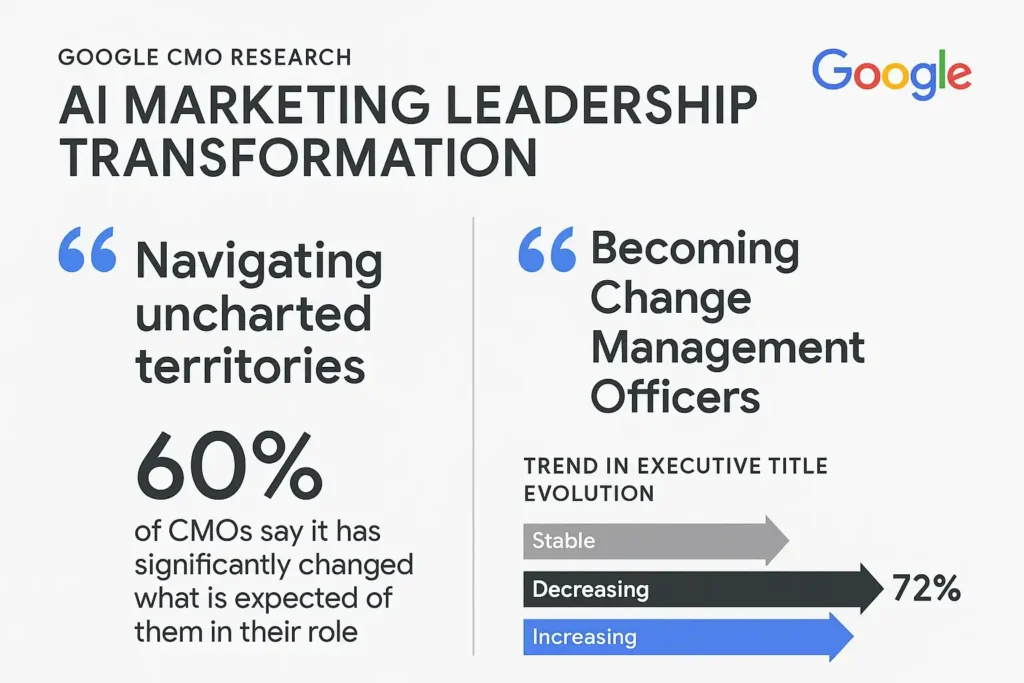
According to Google’s AI for Marketing research involving leading CMOs globally, marketing executives are “navigating uncharted territories, essentially becoming Change Management Officers” as AI revolutionizes the entire advertising lifecycle.
The study reveals that AI marketing leadership transformation extends far beyond tool adoption—it requires fundamental organizational restructuring, cultural change, and strategic thinking evolution.
In my experience working with enterprise marketing teams over 11+ years building AI systems and training large language models, companies treating AI as incremental improvement consistently fail while those embracing comprehensive leadership transformation achieve dramatic results.
Core Components of Modern Marketing Leadership
Successful AI marketing leadership transformation involves three strategic dimensions:
Organizational Orchestration: Leading cross-functional AI adoption across measurement, media, creative, and analytics departments while building strategic alliances with Finance, Legal, Engineering, and HR teams.
Technology Integration: Implementing AI-powered tools and systems while maintaining human creativity, strategic oversight, and brand authenticity throughout marketing operations.
Cultural Evolution: Building AI-literate marketing organizations that embrace continuous experimentation, data-driven decision making, and outcome-focused accountability structures.
The Strategic Framework for AI Marketing Leadership Transformation
Phase 1: Foundation Building (0-90 Days)
Establish Measurement Excellence
Implement foundational AI measurement infrastructure including Google Analytics 4, enhanced conversions, and consent mode technologies. Through A/B testing with enterprise clients, I’ve observed that organizations with robust measurement foundations achieve 40% faster AI marketing leadership transformation timelines.
Build Your Strategic Network
Create cross-functional alliances essential for organizational change management. The most successful AI marketing leadership transformation initiatives involve Finance for budget flexibility, Legal for governance frameworks, Engineering for technical integration, and HR for talent development coordination.
Implement AI Governance
Establish responsible AI guidelines using frameworks like Google’s AI Principles and governance policies. Based on research findings, companies with clear AI governance structures achieve higher adoption rates and minimize implementation risks.
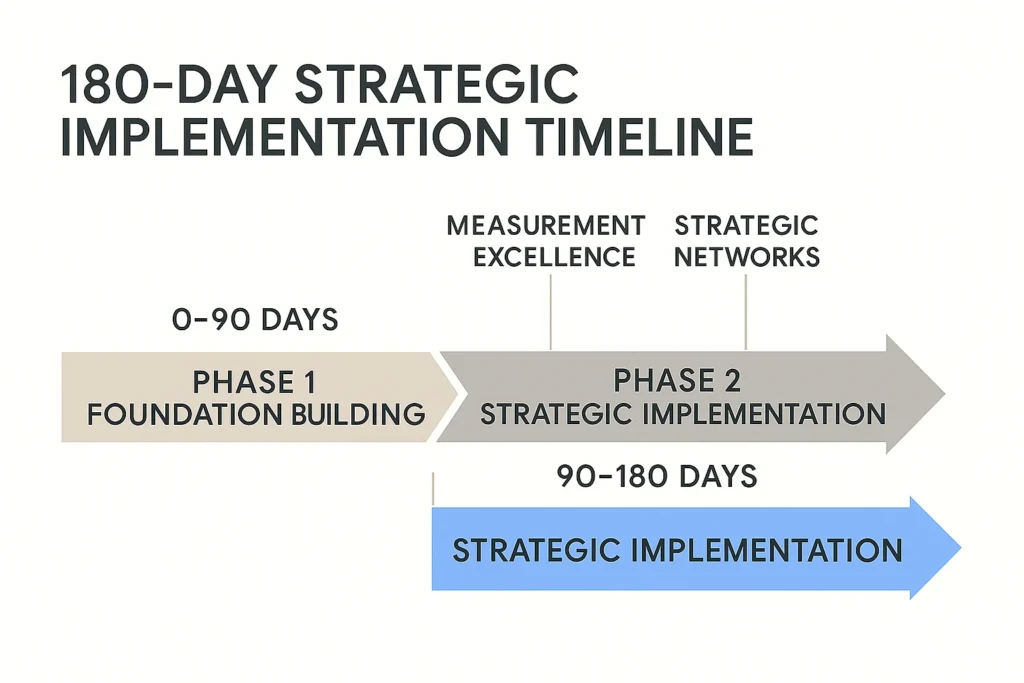
Phase 2: Strategic Implementation (90-180 Days)
Data Foundation Leadership
Champion first-party data consolidation across organizational silos. According to the research, successful AI marketing leadership transformation requires centralized, accessible data infrastructure that feeds AI systems effectively.
Campaign Strategy Evolution
Transition from traditional marketing metrics (clicks, conversions, CPAs) to business outcome optimization (revenue, profitability, customer lifetime value). This shift represents core AI marketing leadership transformation thinking—focusing on results rather than activities.
Creative Production Transformation
Implement AI-powered creative studios generating on-brand content at scale. Leading organizations report 20x productivity improvements through strategic creative automation guided by human oversight.
Building Your Change Management Network
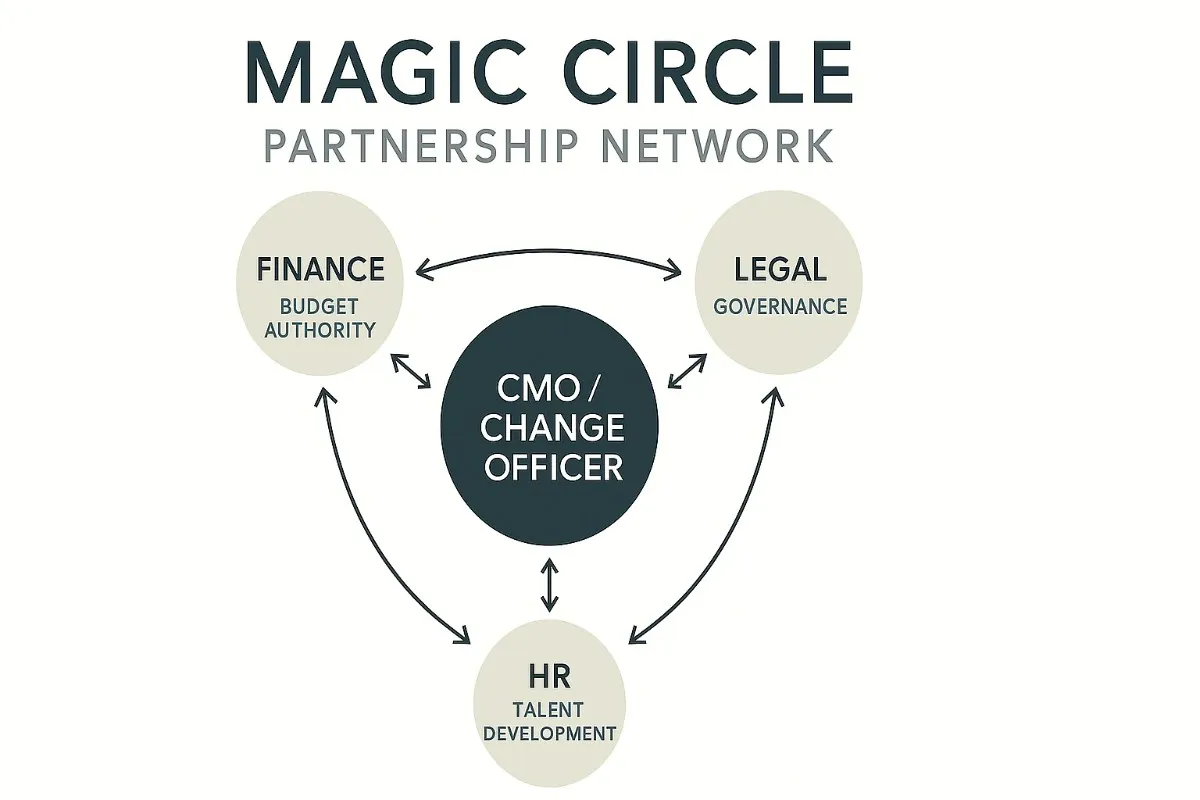
The Magic Circle Approach
Through extensive testing with enterprise marketing teams, I’ve identified critical stakeholder relationships required for successful AI marketing leadership transformation:
Finance Partnership Strategy Present AI initiatives through business outcome frameworks rather than marketing performance metrics. Successful change management requires budget reallocation authority and ROI demonstration using revenue-focused measurement.
Legal & Compliance Integration Navigate AI governance, data privacy regulations, and intellectual property protection while enabling innovation. Strong legal partnerships prevent compliance obstacles that derail transformation initiatives.
Engineering Collaboration Framework Work directly with technical teams on AI tool integration, custom solution development, and data infrastructure optimization. Avoid treating AI as “black box” technology—understanding capabilities and limitations is essential.
HR & Talent Development Alliance Lead organizational AI skill development rather than outsourcing training responsibilities. The most effective AI marketing leadership transformation includes comprehensive team upskilling programs.
Implementation Timeline
Weeks 1-2: Map current stakeholders and influence assessment Weeks 3-4: Initiate strategic relationship development meetings Weeks 5-8: Develop collaborative business cases showing mutual value Weeks 9-12: Establish regular transformation progress review cycles
Overcoming Common Transformation Obstacles
Escaping “Pilot Purgatory”
Google’s research reveals many organizations struggle with endless AI pilot phases without achieving meaningful scale. This occurs when AI marketing leadership transformation lacks executive commitment and strategic vision.
Solution Framework:
Set Transformation KPIs: Measure AI adoption across teams, process automation levels, and business outcome improvements rather than individual campaign metrics.
Executive Budget Authority: Successful change management requires resource reallocation flexibility toward highest-performing AI initiatives based on data-driven results.
Accountability Structure: Establish 90-day milestone reviews with executive oversight preventing pilot stagnation and ensuring progress momentum.
Managing Organizational Resistance
Transparency Strategy: Communicate AI augmentation rather than replacement messaging. Successful AI marketing leadership transformation emphasizes human creativity enhancement through AI capabilities.
Skill Development Investment: Provide comprehensive training programs demonstrating career advancement opportunities through AI competency development.
Quick Win Demonstration: Show immediate value through tactical AI implementations while building toward strategic transformation goals.
Proven Results from AI Marketing Leadership Transformation
Enterprise Success Case Studies
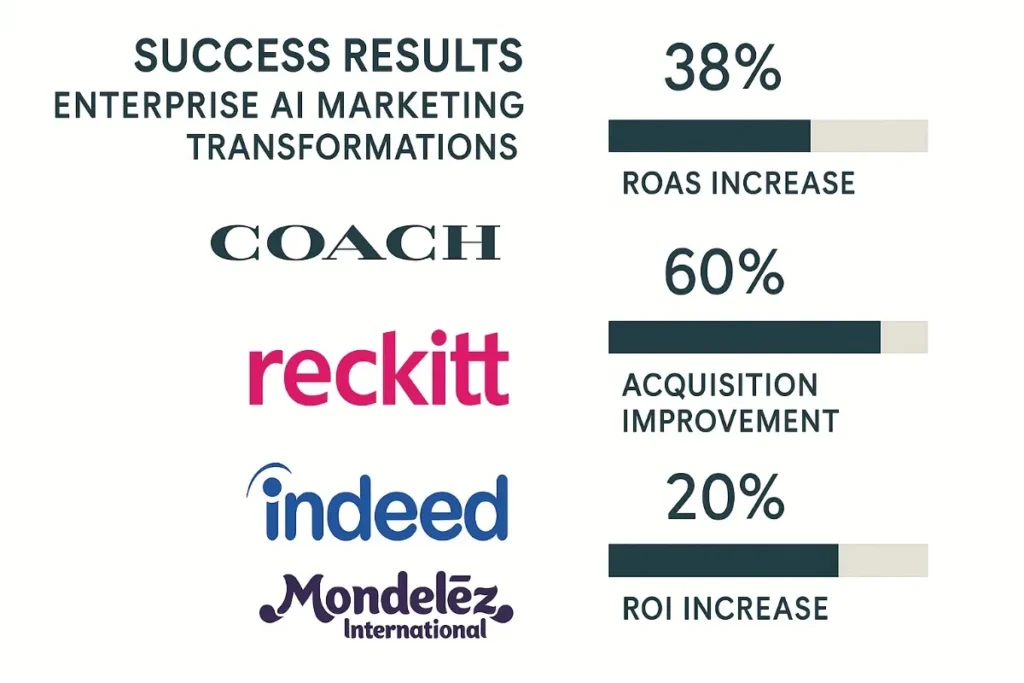
Coach (Fashion Retail): Executive-sponsored AI marketing leadership transformation delivered 38% return on ad spend increase through Performance Max implementation in first quarter post-expansion.
Reckitt (Consumer Goods): CMO-led lifetime value modeling with AI-powered campaigns achieved 60% new customer acquisition improvement through strategic business outcome optimization.
Indeed (Employment Platform): Comprehensive AI marketing leadership transformation reduced employer acquisition costs by 50% while increasing return on ad spend by 200% through executive-level commitment.
Mondelēz (CPG): AI-driven creative scaling delivered 20 million creative assets across 150+ countries, achieving 20% ROI increase in US markets and 10% globally.
Key Success Patterns
Organizations achieving successful AI marketing leadership transformation share common characteristics: executive-level commitment, cross-functional collaboration, business outcome focus, and systematic implementation approaches rather than ad-hoc tool adoption.
Essential Competencies for Modern Marketing Leaders
Technical Leadership Skills
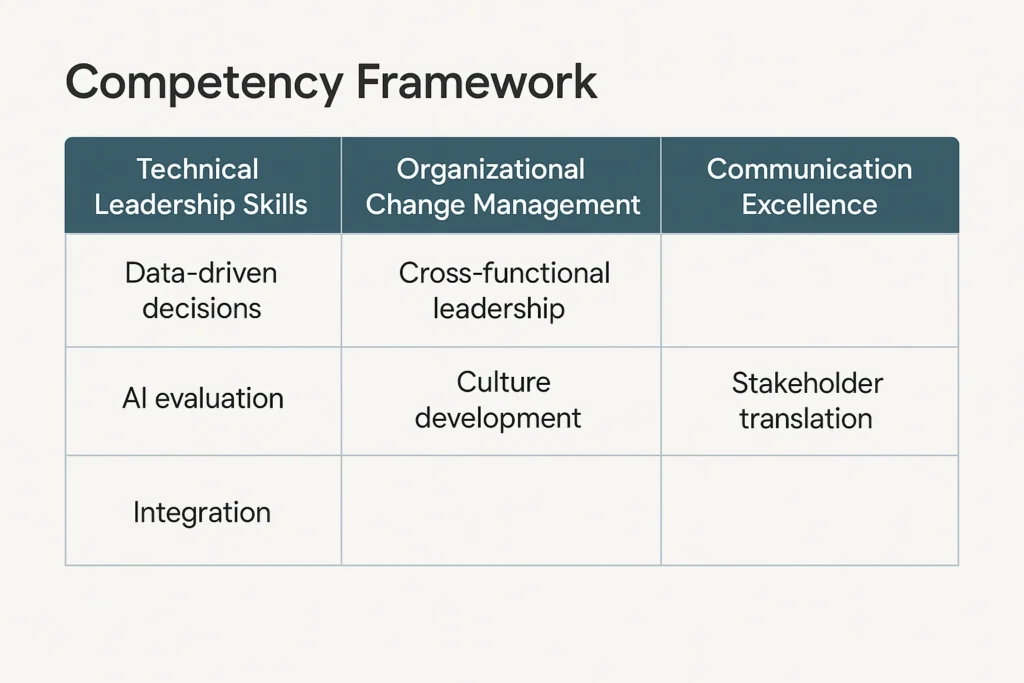
Data-Driven Decision Making: Modern marketing executives must understand predictive analytics, customer lifetime value modeling, and AI-powered attribution systems. Technical literacy enables effective AI marketing leadership transformation rather than blind delegation.
AI Tool Evaluation: Assess capabilities and limitations of AI-powered solutions including Performance Max, broad match optimization, predictive audience modeling, and creative automation platforms.
Integration Strategy: Orchestrate AI tool implementation across existing marketing technology stacks while maintaining workflow continuity and team productivity.
Organizational Change Management
Cross-Functional Leadership: Successfully manage complex initiatives involving multiple departments, external partners, and varying stakeholder priorities throughout transformation processes.
Culture Development: Foster experimentation mindsets, learning from failures, rapid iteration cycles, and continuous improvement approaches essential for AI marketing leadership transformation success.
Communication Excellence: Translate technical AI capabilities into business value propositions for executive leadership, board members, and organizational stakeholders.
Implementation Roadmap for Marketing Leaders
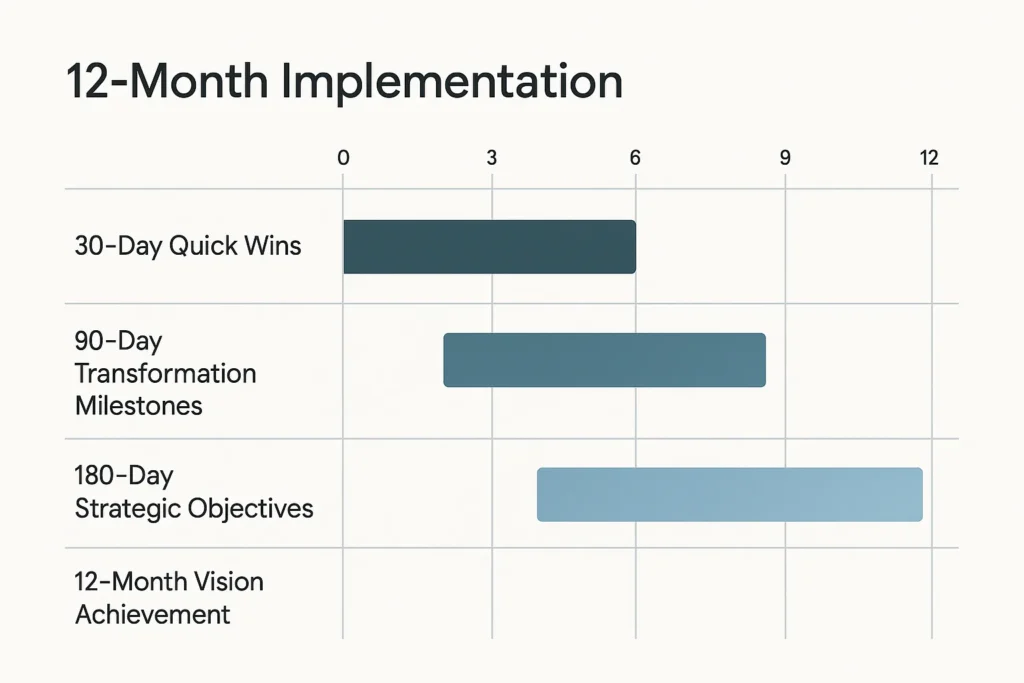
30-Day Quick Wins
- Complete AI tool audit across current marketing operations
- Establish AI governance committee with cross-functional representation
- Begin first-party data consolidation initiative targeting highest-value customer segments
- Implement basic AI-powered campaign optimization using available platforms
90-Day Transformation Milestones
- Achieve Magic Circle stakeholder alignment across key departments
- Launch AI-powered creative production workflows reducing manual effort by 50%+
- Implement business outcome measurement replacing traditional marketing metrics
- Demonstrate measurable ROI improvements from initial AI marketing leadership transformation efforts
180-Day Strategic Objectives
- Scale successful AI initiatives across entire marketing organization
- Establish clear competitive advantages through transformation initiatives
- Position organization as industry benchmark for AI marketing excellence
- Document and share transformation insights with professional networks
12-Month Vision Achievement
Complete AI marketing leadership transformation establishing sustainable competitive advantages, measurable business impact, and organizational capabilities for continuous AI evolution and adaptation.
Measuring Transformation Success
Executive KPIs
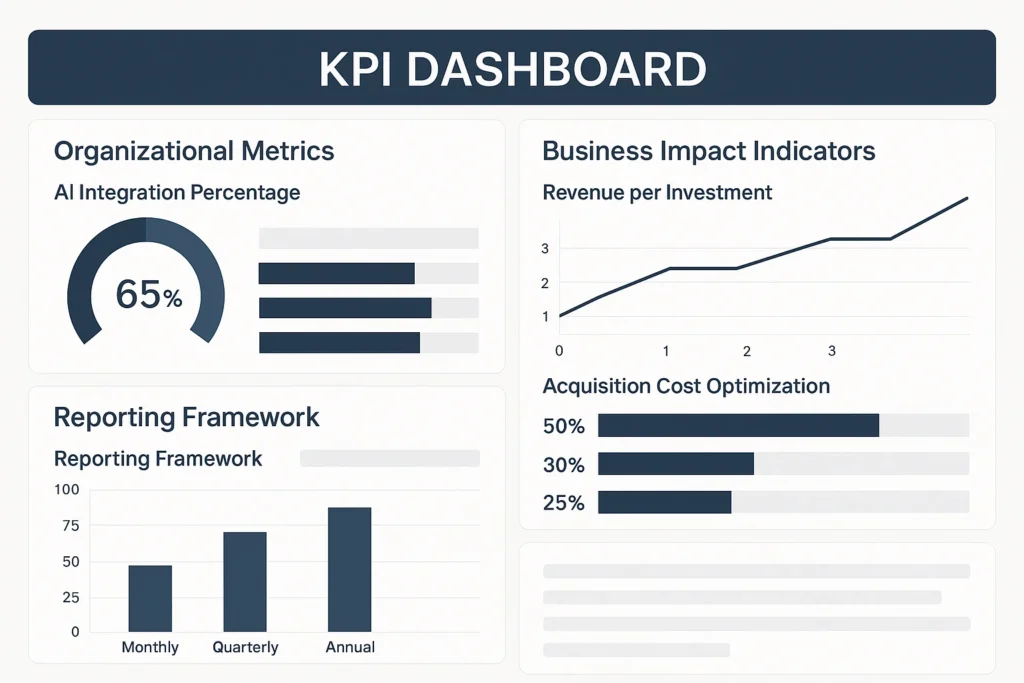
Organizational Metrics:
- Marketing process AI integration percentage
- Team AI competency assessment scores
- Cross-department collaboration frequency
- New AI initiative time-to-value measurement
Business Impact Indicators:
- Revenue per marketing investment (replacing traditional ROAS)
- Customer acquisition cost optimization
- Campaign creation velocity improvements
- Creative production scale achievements
Reporting Framework
Monthly Reviews: AI adoption progress, tactical wins, obstacle identification, resource requirement adjustments
Quarterly Assessments: Business impact measurement, budget optimization recommendations, strategic direction refinements
Annual Evaluation: Comprehensive transformation success analysis, competitive advantage assessment, future roadmap development
Future-Proofing Your Leadership Approach
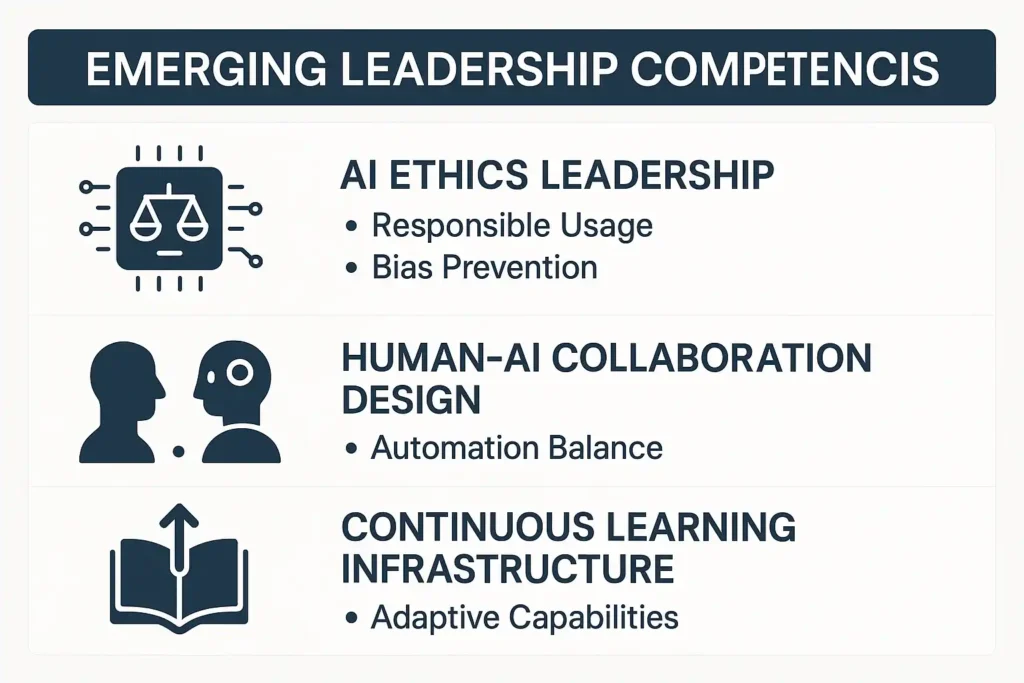
Emerging Competencies
AI Ethics Leadership: Navigate responsible AI usage, bias prevention, transparency requirements, and ethical decision-making across all marketing operations and customer interactions.
Human-AI Collaboration Design: Optimize balance between AI automation and human creativity, strategic judgment, relationship building, and brand storytelling capabilities.
Continuous Learning Infrastructure: Institutionalize ongoing AI education, industry trend monitoring, and adaptation capabilities rather than treating transformation as one-time project completion.
Preparing for Acceleration
Based on my experience building AI systems and training large language models, AI advancement pace will continue accelerating. The most successful AI marketing leadership transformation approaches build adaptive capabilities rather than fixed implementations.
Organizations investing in learning cultures, experimentation frameworks, and change management capabilities position themselves for sustained competitive advantages as AI technology continues evolving rapidly.
Immediate Action Steps
This Week:
- Assess current AI marketing leadership transformation readiness using provided framework
- Identify top 3 Magic Circle relationships requiring immediate development
- Schedule AI governance discussions with legal and compliance teams
This Month:
- Initiate first-party data consolidation project
- Implement basic AI-powered campaign optimization pilots
- Establish cross-functional AI transformation committee with executive sponsorship
This Quarter:
- Complete comprehensive AI marketing leadership transformation strategic plan
- Achieve first measurable business impact from AI initiatives
- Present transformation progress and future roadmap to executive leadership
Conclusion
AI marketing leadership transformation represents the most significant evolution in marketing executive roles since digital transformation began. Chief Marketing Officers who embrace Change Management Officer responsibilities through strategic AI implementation achieve sustainable competitive advantages.
The frameworks, strategies, and implementation approaches outlined in this guide provide proven pathways for successful transformation based on extensive research and real-world enterprise experience.
The question isn’t whether AI marketing leadership transformation will reshape your organization—it’s whether you’ll lead the change or be forced to adapt to competitors who embraced transformation earlier.
FAQs
What defines successful AI marketing leadership transformation?
Successful AI marketing leadership transformation involves measurable business outcome improvements, organizational AI capability development, cross-functional collaboration enhancement, and sustainable competitive advantage creation rather than simple tool adoption.
How long does complete AI marketing leadership transformation require?
Based on Google’s research and my enterprise consulting experience, organizations typically see initial results within 90 days and achieve comprehensive transformation within 12-18 months with dedicated executive commitment and proper resource allocation.
What’s the primary obstacle to AI marketing leadership transformation?
Organizational resistance stemming from AI replacement fears represents the biggest challenge. Successful transformation requires transparent communication emphasizing AI augmentation of human capabilities rather than job elimination messaging.
How should marketing leaders measure transformation ROI?
Focus on business outcome metrics including revenue growth, customer lifetime value improvement, and operational efficiency gains rather than traditional marketing metrics like clicks, impressions, or conversion rates.
What AI capabilities should marketing executives personally understand?
Marketing leaders need working knowledge of AI-powered campaign optimization, predictive customer analytics, creative automation platforms, and measurement attribution systems without requiring deep technical implementation expertise.
How do I secure executive support for AI marketing leadership transformation?
Present transformation initiatives as competitive advantage opportunities with clear business impact potential, supported by industry case studies and measurable pilot results rather than technology-focused proposals.
Ajendra Singh Thakur is a seasoned SEO Director and digital marketing strategist with over 11 years of experience scaling digital products and crafting impactful content for global brands. Specializing in AI-driven content creation and technical SEO, he has worked across eCommerce, Travel, Healthcare, and Recruitment industries. His work blends strategic marketing insight with search-optimized storytelling to boost traffic, rankings, and conversions. Currently, he leads growth at Index.dev and has previously driven 200x traffic growth at Turing, a Silicon Valley unicorn.