10 Best LLM Visibility Tools in 2026, Compared (Data-Backed)
 By Ajendra Singh Thakur
Updated August 2026
12 min read
By Ajendra Singh Thakur
Updated August 2026
12 min read
The best LLM visibility tools in 2026 are Rankscale (best engine coverage per dollar, 17+ providers from ~$20/mo), the Semrush AI Toolkit (best add-on if you already use Semrush, $99/mo), Otterly.AI (best budget entry, $29/mo), and Scrunch AI (best for attribution, with GA4 integration). HubSpot's free AEO Grader is the fastest way to get a baseline before paying for anything. Entry pricing spans free to $800+/month for the same core job, so price your actual prompt count before comparing headline numbers and remember these tools only measure visibility, they don't create it; closing citation gaps still takes content and entity work.
The best LLM visibility tools in 2026 are Rankscale (best engine coverage per dollar), the Semrush AI Toolkit (best add-on if you already run Semrush), Otterly.AI (best budget entry at $29/month), and Scrunch AI (best attribution). HubSpot’s free AEO Grader is the fastest way to get a baseline before paying for anything.
Quick picks
- Best coverage per dollar: Rankscale, 17+ AI providers from roughly $20/month
- Best if you already pay for Semrush: Semrush AI Visibility Toolkit, $99/month add-on
- Best budget entry: Otterly.AI, $29/month
- Best for attribution: Scrunch AI, GA4 integration at $300/month
- Best free starting point: HubSpot AEO Grader, one-time snapshot
- Best prompt database: Ahrefs Brand Radar, if the budget survives it
Comparison table
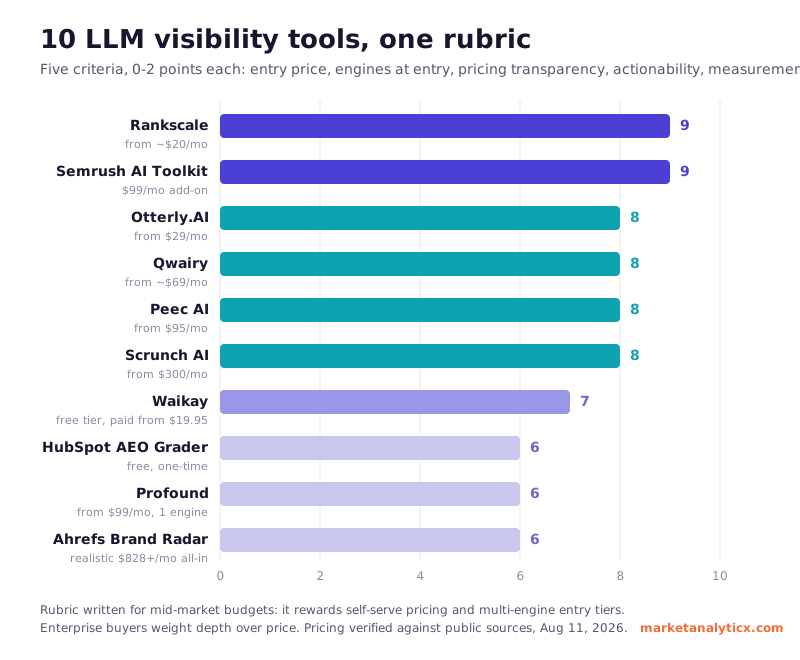
| Tool | Entry price | Engines at entry | Prompts at entry | Standout | Score /10 |
|---|---|---|---|---|---|
| Rankscale | ~$20/mo (credits) | 17+ providers | credit-based | Coverage + technical audits | 9 |
| Semrush AI Toolkit | $99/mo add-on | 9 | prompt tracking incl. | 213M+ prompt database | 9 |
| Otterly.AI | $29/mo | 4 | 15 | 1,000 GEO URL audits on Lite | 8 |
| Qwairy | ~$69/mo (€59) | 10+ providers | flat, no surcharges | GSC integration, MCP server | 8 |
| Peec AI | $95/mo | 3 (of 7) | 50 | Unlimited seats, Actions roadmap | 8 |
| Scrunch AI | $300/mo | 7-8 incl. Claude | 350 | GA4 AI-referral attribution | 8 |
| Waikay | Free tier; $19.95+ | 3-4 | monthly checks | Fact-accuracy flagging | 7 |
| HubSpot AEO Grader | Free | 3 | preset | Zero-friction baseline | 6 |
| Profound | $99/mo | 1 (ChatGPT) | 50 | Enterprise depth, Agents | 6 |
| Ahrefs Brand Radar | $199/index + base | up to 6 + social beta | database-driven | 240-260M real-prompt corpus | 6 |
How we chose (and why another list exists at all)
While pulling the search results for this exact query on August 11, 2026, we noticed something worth disclosing: at least half of the roundups ranking for “LLM visibility tools” are published by the vendors themselves, and at least three put their own product at number one. Worth remembering the next time a list crowns its own author.
So this list works differently. Full disclosure: we run a free LLM Visibility Checker of our own, and we deliberately left it out of this ranking so the list stays clean. No vendor here paid for placement, we earn nothing from any of them, and every price was verified against public sources on August 11, 2026. Each tool is scored 0-2 on five disclosed criteria: entry-price accessibility, engine coverage at the entry tier, pricing transparency, actionability (does it tell you what to do, or just what happened), and measurement depth. The rubric is written for mid-market budgets, which is who we work with; enterprise buyers will weight depth over price and should read the Profound and Ahrefs entries accordingly. This is desk research, not a hands-on lab test, and we say so wherever it matters.
1. Rankscale: best coverage per dollar
Verdict: the widest engine net at the lowest published entry price in the category.
Best for: teams that want to see across many AI surfaces before committing real budget.
Rankscale tracks more than 17 AI providers across all regions, with run intervals from hourly to monthly, and adds technical audits, shareable dashboards, and white-label reporting plus API access on higher tiers. Entry is a credit-based Essentials plan from around $20/month; Pro is $99 with 1,200 credits.
Watch-outs: the credit model is the catch. Different providers burn credits at different rates, so you need to model your prompt set before you can predict your bill. Buyers who want a flat, predictable line item will find the math annoying.
2. Semrush AI Visibility Toolkit: best marginal add-on
Verdict: if your team already lives in Semrush, this is the cheapest credible route to AI visibility data from either of the two SEO incumbents.
Best for: Semrush shops adding AI tracking without adding a vendor.
The toolkit is a $99/month add-on per domain that tracks visibility, mentions, sentiment, and citations across nine engines, including ChatGPT, Gemini, AI Overviews, AI Mode, Perplexity, Claude, Copilot, Grok, and DeepSeek. Semrush says the underlying database covers 213M+ prompts. Semrush One bundles from $199/month fold full AI visibility into the SEO limits, which is a different purchase from the $139.95 SEO-only Pro plan, an easy thing to misread on their pricing page.
Watch-outs: it is an add-on, and it behaves like one. Standalone buyers who use neither suite will find a dedicated tracker simpler. And interpreted “insights” layered on top of the data are part of what you pay for; teams that just want raw data may not value them.
3. Otterly.AI: best budget entry
Verdict: the cheapest paid plan we would actually recommend, and one of the few vendors that publishes every price.
Best for: small teams monitoring one brand on 15 prompts.
Lite is $29/month for 15 prompts across four engines, 1,000 GEO URL audits, 50+ country tracking, and unlimited team members. Standard at $189 adds 100 prompts plus API and MCP access; Premium is $489. Annual billing takes roughly 15% off.
Watch-outs: Gemini and Google AI Mode are paid add-ons at $9-149/month depending on tier, so price your engine list before comparing headline numbers. Lite has no API access, so it is tracking-only.
4. Qwairy: best flat-price breadth
Verdict: the widest coverage under $70, if you take the vendor’s published numbers at face value.
Best for: teams that hate per-engine surcharges.
Per Qwairy’s published pricing, €59/month (about $69) buys tracking across 10+ AI providers and 38+ models with no per-provider surcharges, plus an MCP server, AI crawler detection, and Google Search Console integration, with a 7-day trial. That GSC hook matters: it puts AI answers and classic search data in one workflow.
Watch-outs: our figures here come from Qwairy’s own materials; independent third-party coverage is thinner than for the tools above. It is also more platform than some teams need on day one, by the vendor’s own admission.
5. Peec AI: best for mid-market marketing teams
Verdict: the mid-market favorite, with the category’s most praised support and one genuine pricing gotcha.
Best for: in-house marketing and SEO teams that want the whole team in the tool.
Starter is $95/month for 50 prompts and your choice of 3 of 7 engines, one project, and unlimited seats. Pro is $245 (150 prompts), Advanced $495 (350). The Actions feature, currently in beta, clusters citation gaps into a prioritized roadmap of owned and earned media moves. That pushes Peec past monitoring into “what do I do about it” territory. Independent reviewers consistently praise the support; there is direct Slack access to the founding team even on lower tiers, and the company raised $29M through a November 2025 Series A.
Watch-outs: the three-engine cap is the gotcha. A fourth engine costs $35-165/month depending on plan, and Claude is only available on the custom Enterprise tier. One April 2026 analysis found that full engine coverage can push the effective cost of the entry plan to roughly double the headline price. Reviewers also call the interface bland, though a plain interface is arguably the right call for a tool this dense.
6. Scrunch AI: best for attribution
Verdict: connects AI visibility to actual site visits. Sooner or later your CFO asks for exactly that.
Best for: teams that need to prove AI search is driving traffic, and enterprises with security checklists.
Business is $300/month for 350 prompts across seven to eight LLMs, with Claude included at base price. The GA4 integration shows real AI-referral traffic, SOC 2 Type II and SSO cover the security review, and its Agent Experience Platform prepares sites for visits from AI agents on top of AI answers. The company has raised $15M.
Watch-outs: data refreshes every three days, where Otterly and Peec run daily. At $300 entry it is also the priciest tool in this list’s self-serve tier.
7. Waikay: best for fact accuracy
Verdict: a different job than the rest of this list: not “am I mentioned” but “is what the AI says about me true.”
Best for: brands fighting AI misinformation or stale facts.
Waikay builds a knowledge graph of your brand and compares it against what LLMs assert, extracting specific claims and letting you flag the wrong ones. There is a free monthly monitoring tier, with paid plans from $19.95 to $199.95/month, covering ChatGPT, Gemini, Sonar, and Claude data.
Watch-outs: narrower engine coverage and a reputation-management center of gravity. If your problem is share of voice rather than wrong facts, other tools here fit better.
8. HubSpot AEO Grader: best free starting point
Verdict: the fastest zero-cost baseline in the category, and the right first step before any subscription.
Best for: anyone who has never checked their AI visibility.
The Grader is a free, one-time diagnostic with no account required. It scores sentiment, presence quality, brand recognition, share of voice, and market position across ChatGPT, Perplexity, and Gemini using preset queries. HubSpot’s paid AEO product, from $50/month, adds continuous tracking, and the company acquired XFunnel in 2026 to build the line out.
Watch-outs: it is a snapshot, not a monitor, and ChatGPT and Gemini results pull from training data rather than live consumer answers, so treat the score as directional. A one-time grade tells you where you stand today and nothing about next month.
9. Profound: best for enterprise reporting
Verdict: the category’s best-funded specialist and a G2 Leader, priced and packaged for enterprises rather than the mid-market.
Best for: large brands that need board-level AI visibility reporting and have budget to match.
Profound has raised $58.5M, including a $35M Series B led by Sequoia, and G2 named it a Leader in the inaugural Answer Engine Optimization category in Winter 2026. Third-party reviews consistently report a $99 Starter and a $399/month Growth tier covering three engines and 100 prompts with agent automation credits, and put enterprise deployments at $2,000 to $5,000+/month. Profound itself does not publish a clean public price ladder.
Watch-outs: the Starter tier tracks ChatGPT only, which surprises buyers comparing headline prices, and the official pricing page is demo-led rather than self-serve, so treat the dollar figures above as reported figures rather than list prices. The recurring reviewer complaint is prompt limits for the price; one enterprise G2 reviewer also warned the packaging tempts you to track more topics than you can act on. Strong product, enterprise shape.
10. Ahrefs Brand Radar: best prompt database
Verdict: the deepest data asset in the category attached to the heaviest realistic bill.
Best for: research-heavy teams already on Ahrefs that want to study how brands appear across real user prompts at scale.
Brand Radar queries a real-prompt corpus in the 240 to 260 million range. Nothing else in the category comes close to that dataset. It tracks up to six AI platforms plus beta monitoring of YouTube, TikTok, and Reddit. Since June 30, 2026, all platforms roll into one unified report view. Pricing is $199/month per AI index or $699/month for all platforms, on top of an Ahrefs base plan from $129/month.
Watch-outs: the realistic all-in cost for full coverage lands around $828 to $1,148/month, several times the Semrush add-on. You are paying for the database, which is superb for research and less obviously worth it for day-to-day tracking.
How to choose
If you have never checked your AI visibility, run the free HubSpot Grader today; it costs nothing and sets the baseline. If you need the cheapest real monitor, take Otterly Lite at $29. If your team already pays for Semrush or Ahrefs, price the add-on before adding a vendor; the Semrush toolkit at $99 is the cheaper of the two by a wide margin. If you need breadth across many engines on a small budget, model your prompts in Rankscale or take Qwairy’s flat plan. If you must prove traffic impact to leadership, Scrunch’s GA4 integration is the shortest path. And if AI visibility is becoming a board metric with real budget behind it, Profound and Ahrefs are the enterprise conversation.
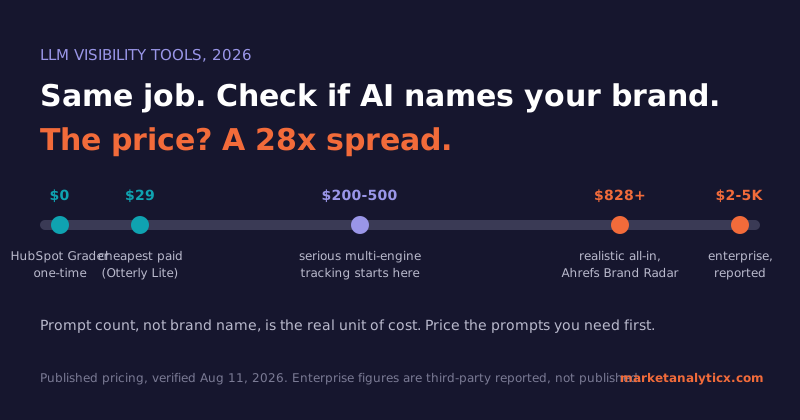
One rule regardless of tool: prompt count is the real unit of cost. A 25-prompt plan covers one product line in one market. Multiple products across multiple regions push almost every vendor into a higher tier, so price the prompts you actually need before comparing headline numbers.
What these tools can and cannot do
Three limitations apply to the whole category. First, measurement methods differ: some tools query LLM APIs, and API responses do not always match what users see in the consumer apps, a discrepancy practitioners keep flagging. Ask any vendor how they collect answers before trusting the numbers. Second, AI answers are volatile; the same prompt returns different answers run to run, so read trends over weeks, not single snapshots. Third, and most important: these tools measure visibility, they do not create it. As one PR-industry analysis put it, buying a tracker and expecting citations to appear is like buying a scale and expecting to lose weight. The tracker tells you where the gaps are; closing them is content, citations, and entity work.
Pricing in this category also changes monthly. Every figure above was verified against public sources on August 11, 2026; check the vendor’s live page before you buy.
FAQ
Bottom line
The category splits into three buckets: free baselines (HubSpot Grader, Waikay’s free tier), self-serve monitors from $20-300/month (Rankscale, Otterly, Qwairy, Peec, Semrush, Scrunch), and enterprise platforms priced by conversation (Profound, Ahrefs Brand Radar at full stretch). Start with the free baseline, pick the tier your prompt count actually requires, and remember the tool only finds the gaps. Turning citation gaps into content decisions every week is the part no subscription does for you; that operating layer is what we build at Market Analyticx, and where our GEO services pick up exactly where these trackers stop.
Key takeaways
- Entry pricing spans $0 to a realistic $828+/month for the same core job, a 28x spread across paid plans; price prompts, not brand names.
- Rankscale and the Semrush AI Toolkit score highest on our mid-market rubric; Otterly is the cheapest recommendable paid plan at $29/month.
- At least half the roundups ranking for this query are vendor-published; check who wrote any list before trusting its number one.
- No tracker creates visibility. Budget for the content and citation work the data points to.
- Verify pricing on live vendor pages before buying; figures here were checked August 11, 2026.
Ajendra Singh Thakur is a seasoned SEO Director and digital marketing strategist with over 11 years of experience scaling digital products and crafting impactful content for global brands. Specializing in AI-driven content creation and technical SEO, he has worked across eCommerce, Travel, Healthcare, and Recruitment industries. His work blends strategic marketing insight with search-optimized storytelling to boost traffic, rankings, and conversions. Currently, he leads growth at Index.dev and has previously driven 200x traffic growth at Turing, a Silicon Valley unicorn.