How to Do GEO in 2026-2027: Get Your Brand Recommended by AI
 By Ajendra Singh Thakur
Updated September 2026
11 min read
By Ajendra Singh Thakur
Updated September 2026
11 min read
Generative Engine Optimization (GEO) means structuring your content so AI engines like ChatGPT, Perplexity, and Google AI Overviews cite or recommend your brand inside generated answers, instead of just ranking in a list of links. The three tactics proven to work best citing sources, adding direct quotations, and including statistics each lifted AI visibility 30-40% in the Princeton GEO study. GEO doesn't replace SEO; most AI citations still go to pages that already rank well organically. The key mindset shift: optimize the passage, not the page, since engines retrieve and cite self-contained chunks and measure citation share of voice and AI-referral conversions instead of clicks, since click-through rates on AI-heavy queries have genuinely dropped.
Generative Engine Optimization (GEO) is the practice of structuring your content and online presence so AI answer engines such as ChatGPT, Perplexity, Google AI Overviews, Gemini, and Claude cite, quote, or recommend your brand inside the answers they generate. You do it by front-loading direct answers, backing claims with statistics and cited sources, publishing original data, marking up pages with schema, building author and entity authority, and earning mentions on the third-party sites those engines already trust.
That is the whole playbook in one paragraph. The rest of this guide is the detail, the evidence, and the order to do it in.
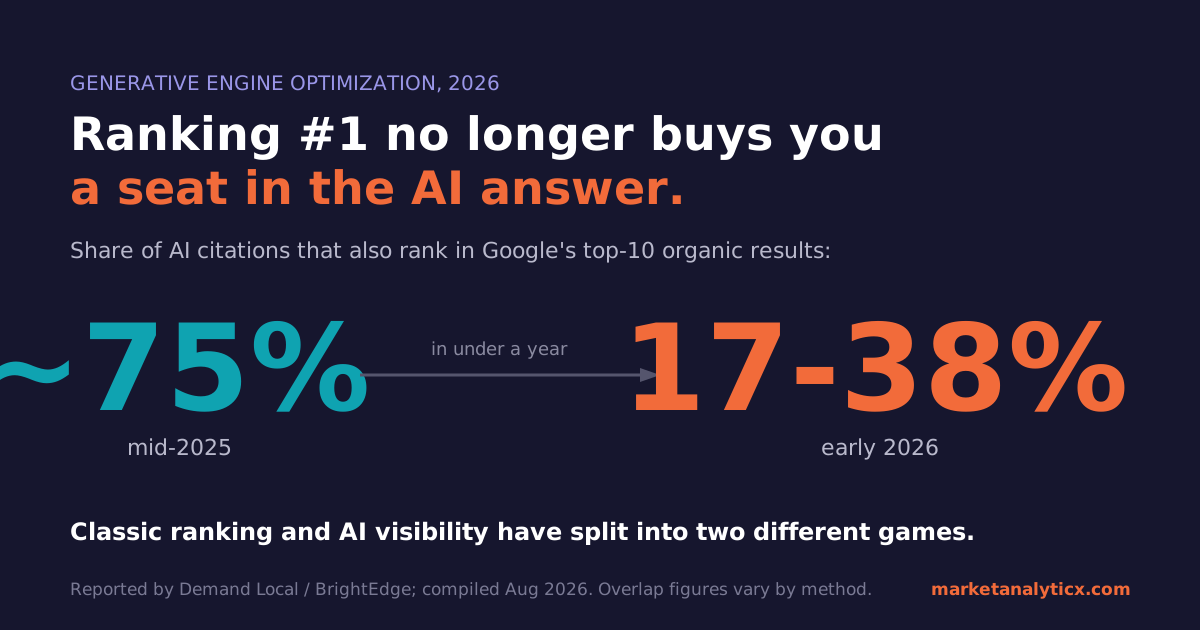
One thing to settle first, because it reframes everything below. In mid-2025, roughly 75% of the sources AI engines cited also ranked in Google’s top-10 organic results. By early 2026 that overlap had reportedly fallen to somewhere between 17% and 38%, per tracking from Demand Local and BrightEdge. Ranking first and getting recommended by AI have become two different games. If your strategy still assumes that winning Google wins everything, you are optimizing for a world that is already closing.
What GEO is (and how it differs from SEO and AEO)
GEO optimizes for a citation inside a generated answer. SEO optimizes for a position in a list of links. Those are two different targets, and they reward different things.
Traditional SEO has long rewarded keyword targeting, backlinks, and page authority to climb the rankings. GEO rewards clarity, quotable evidence, and machine-readable structure so an engine can lift your passage into its answer, often with no click at all. The two overlap because both need content that is crawlable, accurate, and authoritative, but they pay off differently.
You will also see the term AEO, Answer Engine Optimization. The industry has not settled on one label, and in daily work the tactics overlap heavily. The useful distinction: AEO targets direct answers to specific questions, the featured-snippet and AI-Overview slots. GEO is broader, covering any content pulled into an AI-generated answer, including longer synthesis, comparisons, and multi-source citations. Treat them as one discipline with two emphases, not two separate jobs.
The most important myth to kill early: GEO does not replace SEO. It builds on it. Roughly 87% of ChatGPT citations match Bing’s top-10 results, and about 94% of Google AI Overview citations link to at least one page already ranking in the top-10 organic results, according to compiled 2026 figures from Mersel AI. As uSERP’s Jeremy Moser puts it, most of GEO is good, fundamental SEO. The engines mostly cite pages that already earn their place; GEO is how you become the one they pick from that shortlist.
How AI engines actually decide who to cite
You cannot optimize for a black box you do not understand, so here is the mechanism in plain terms.
Modern AI answers run on retrieval-augmented generation, or RAG. When someone asks a question, the engine does not paste it whole into a search box. It breaks the question into smaller sub-queries, a behavior often called query fan-out, retrieves the most semantically relevant passages for each, and stitches the strongest into one answer with citations to the passages it leaned on.
That single fact changes your unit of optimization. You are no longer optimizing a page; you are optimizing a passage. Content gets chunked, converted into vectors, and pulled in when a chunk is the best semantic match for a sub-query. Clarity, self-contained claims, and clean structure beat keyword density, because the engine is matching meaning, not counting words. A paragraph that makes a complete, sourced point on its own can be cited; a paragraph that only makes sense after the three above it cannot.
The practical read: write so any single section can be lifted out and still stand up. That is the mental model behind every tactic that follows.
The GEO playbook: what actually moves citations
Here the evidence gets specific. The foundational research is the Princeton GEO study (Aggarwal et al., presented at KDD 2024), the first large-scale academic test of what makes AI engines cite a source. The team ran 10,000 queries through a generative-search system and measured which content changes increased visibility. Five tactics worked; four did nothing or backfired.
The three strongest each delivered a relative lift of roughly 30 to 40% on the study’s visibility metric: citing your sources, adding direct quotations from credible sources, and adding relevant statistics. Improving fluency and adopting a more authoritative voice helped less but still helped. Keyword stuffing, padding, oversimplifying, and pure persuasive language did nothing or actively hurt.
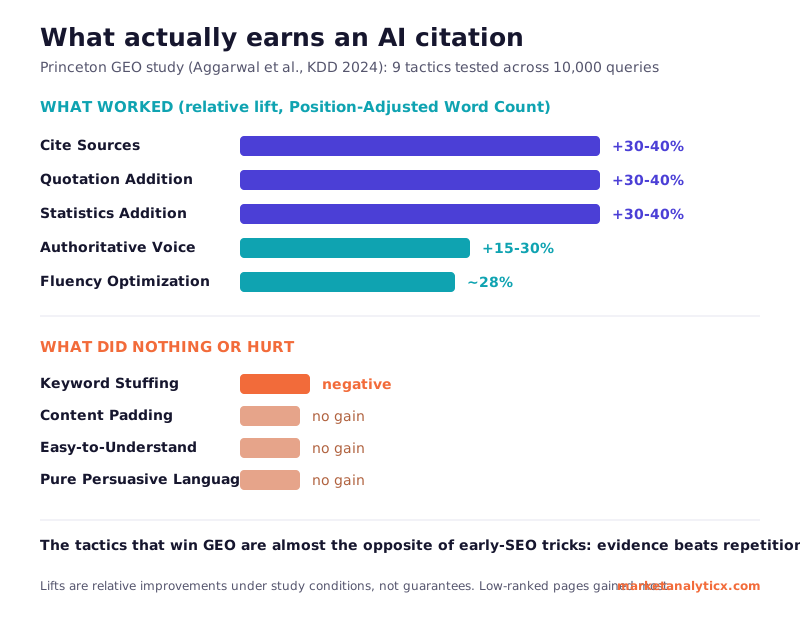
Two caveats keep this honest. Those percentages are relative improvements measured under study conditions, not guarantees for any single page. And the study found the biggest gains went to lower-ranked sources, which is good news if you are not already dominant and a reason for incumbents not to get complacent.
Here is how to turn that into work.
Front-load the answer. Open every section by answering its question in the first one or two sentences, then expand. Engines extract the direct answer; burying it three paragraphs down means it never gets lifted. Aim for a self-contained 40-to-60-word answer near the top of each section and near the top of the page.
Lead with evidence, not adjectives. Since statistics, quotations, and citations are the three highest-performing tactics in the research, build your content around them. Replace “our platform is highly effective” with a specific number and a source. Every strong claim should carry a stat, a named source, or a direct quote. This is the single biggest lever, and most brand content ignores it.
Publish original data. The most durable GEO asset is a number only you have: a benchmark, a survey, an index, a teardown of your own results. Original data is what other people cite, and third-party citations are what engines read as authority. This is the compounding move; everything else is table stakes.
Structure for extraction. One H2 per question. Short, complete paragraphs. Comparison tables for anything with attributes. FAQ sections written so each answer stands alone. Bullet lists for genuinely list-shaped content. The goal is a page an engine can disassemble cleanly into citable parts.
Add schema. Mark up pages with the relevant structured data: FAQPage for question sections, Article with a clearly identified author, Organization for entity clarity, ItemList for ranked or listed content. Schema does not force a citation, but it removes ambiguity about what your content is and who stands behind it.
Build author and entity authority. Put real, credentialed authors on your content, with bios and consistent identity across the web. Engines weigh source credibility, and a clearly identified expert behind a claim is a stronger signal than an anonymous page. Keep your brand’s core facts consistent everywhere they appear so the engine can build a confident picture of who you are.
Earn third-party mentions. Because citing credible sources lifts visibility, being the credible source others cite is the endgame. Get mentioned, quoted, and linked on the sites the engines already read in your category. For most B2B categories that means industry publications, respected blogs, and the specific communities and reference sites the models lean on. Encyclopedic and editorial sources dominate citations: one 2026 index found Wikipedia alone accounted for nearly half of ChatGPT’s top citations.
Answer the next question, not just this one. Because engines fan a query out into related sub-questions, a page that answers the main question plus the obvious two or three follow-ups tends to get pulled across a whole cluster of searches, not just one. Map the natural follow-ups and cover them on the same page.
How to measure GEO (without fooling yourself)
GEO is measurable now, which was not true 18 months ago. But the metrics have shifted, and clinging to the old ones will mislead you.
The headline shift: clicks are no longer the primary success metric; citation and share of voice are. On queries where an AI Overview appears, Seer Interactive measured organic click-through rate falling 61%, from 1.76% to 0.61%. That is real. But cite the number honestly, because the same source’s 2026 update shows CTR rebounding from a December 2025 floor of 1.3% back to 2.4% by February 2026, still below where it started but not the permanent collapse the doom headlines imply. The real picture is erosion followed by a partial bounce, which is a very different thing to plan around than a permanent collapse.
Track these instead:
- Citation presence and share of voice. For your priority prompts, are you cited, and how often versus competitors? This is the AI-search equivalent of rank tracking, and it is the number to lead with. Tools built for this (our own GEO Lens and LLM Visibility Checker among them) score and monitor it; you can also audit manually by running your key prompts and recording who gets named.
- AI-referral traffic in GA4. Small in volume, high in intent. Segment sessions from ChatGPT, Perplexity, and other AI referrers. Every published dataset shows AI-referred visitors convert well above traditional organic, though estimates of how much vary widely, from roughly 3x to more than 20x depending on who is measuring. Treat the direction as reliable and the exact multiple as unsettled.
- Conversions from remaining clicks, not just click volume. When CTR falls but conversions hold, you are losing casual clicks and keeping buyers. Report CTR and conversion as separate numbers, because they are now telling different stories.
One reality check to stay grounded. Despite the shift, Google still sent roughly 88% of all search referrals in mid-2026, while the major AI engines combined sent a fraction of a percent, per Cloudflare Radar. The near-term threat to your traffic is mostly Google answering more on its own results page, not users abandoning it for ChatGPT. GEO is the right long-term bet, but pace your investment to a transition, not an overnight collapse.
Your first 90 days
You do not do all of this at once. A sane order of operations:
Days 1-30, baseline and foundation. Run your priority prompts across ChatGPT, Perplexity, Gemini, and Google AI Overviews and record where you appear and where you are absent. That is your baseline. Pick your ten highest-value prompts, the ones your buyers actually ask. Then fix the fundamentals on your most important existing pages: front-load answers, add the missing statistics and citations, tighten structure.
Days 31-60, structure and authority. Roll the extraction structure across your key pages, add schema, and put credentialed authors on your cornerstone content. Start one original-data asset, the number only you have, because it takes longest to pay off and matters most.
Days 61-90, earn and expand. Publish the original asset and begin earning third-party mentions with it. Expand coverage to the follow-up questions around your core topics. Re-run your baseline prompts and compare: citation presence should be moving on the fundamentals you fixed in month one.
Then repeat. GEO is not a project you finish; it is a loop you run as the engines and your competitors move.
What to watch heading into 2027
The tactics above are stable bets because they are grounded in how retrieval works, not in any one engine’s current quirks. But two things are worth watching. First, AI Overview coverage keeps expanding, sitting near half of Google queries in 2026 and far higher in authoritative categories like healthcare, education, and B2B tech, so the queries where this matters will keep growing. Second, buyer behavior is moving faster than the traffic numbers suggest: G2’s 2026 research found a majority of B2B software buyers now start research in an AI chatbot more often than on Google, up sharply from a year earlier. The referral share is still small; the behavior change underneath it is not.
FAQ
Bottom line
GEO in 2026-2027 comes down to being the best-evidenced, easiest-to-quote source in your category, and then making sure the machines can actually read you. The research is clear about what works: statistics, quotations, citations, clean structure, and real authority. The tactics that fail are the old SEO reflexes, keyword stuffing chief among them.
The mindset shift is the hard part. Ranking first no longer buys you the answer, clicks are no longer the only scoreboard, and the brands winning AI visibility are the ones treating citation and share of voice as the metric that counts. Getting recommended by AI comes down to earning trust, the same as it always has; the only new part is that a machine is now doing the reading. Turning that into a repeatable system, tied to pipeline rather than vanity metrics, is the work we do at Market Analyticx.
Key takeaways
- Ranking and AI visibility have decoupled: top-10 organic overlap with AI citations reportedly fell from about 75% to 17-38% in under a year.
- The three highest-impact GEO tactics are proven: citing sources, adding quotations, and adding statistics each lifted AI visibility 30-40% in the Princeton study.
- Optimize the passage, not the page, because engines retrieve and cite self-contained chunks, not whole documents.
- GEO builds on SEO rather than replacing it; most AI citations still go to pages that already rank.
- Measure citation share of voice and AI-referral conversions, not clicks, and pace investment to a transition, not an overnight collapse.
Ajendra Singh Thakur is a seasoned SEO Director and digital marketing strategist with over 11 years of experience scaling digital products and crafting impactful content for global brands. Specializing in AI-driven content creation and technical SEO, he has worked across eCommerce, Travel, Healthcare, and Recruitment industries. His work blends strategic marketing insight with search-optimized storytelling to boost traffic, rankings, and conversions. Currently, he leads growth at Index.dev and has previously driven 200x traffic growth at Turing, a Silicon Valley unicorn.