What Is Marketing Operations Automation?
 By Ajendra Singh Thakur
Updated August 2026
10 min read
By Ajendra Singh Thakur
Updated August 2026
10 min read
Marketing operations automation means using software to run marketing's repetitive behind-the-scenes work lead scoring and routing, data syncing, audience segmentation, campaign QA, and reporting so the team spends time on strategy and creative instead of manual busywork. The real problem in 2026 isn't a shortage of tools: teams actively use only about 49% of their martech stack, and closer to a third by capability. The fix usually isn't buying more software, it's connecting and actually using what you already own, starting with an audit, then automating reporting and lead routing first, then fixing the data layer before scaling further.
Marketing operations automation is the practice of using software to run the repetitive, behind-the-scenes work that keeps marketing functioning: scoring and routing leads, syncing data between systems, segmenting audiences, running campaign QA, and generating reports. It automates the operational plumbing of marketing, so the team spends its time on decisions and creative work instead of manual busywork.
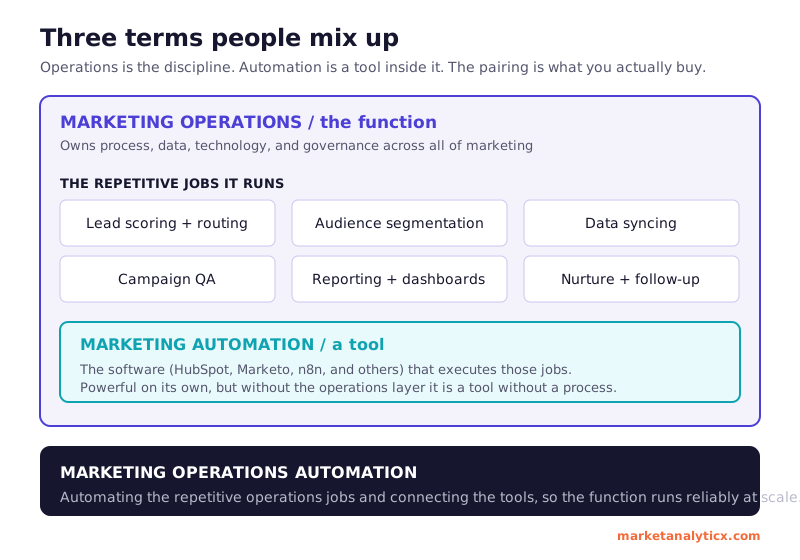
Three terms get used interchangeably here, and they are not the same thing. Marketing operations is the function that owns process, data, technology, and governance across all of marketing. Marketing automation is one tool that function uses. Marketing operations automation is what happens when you automate the function’s repetitive jobs and connect the tools so the whole thing runs reliably at scale.
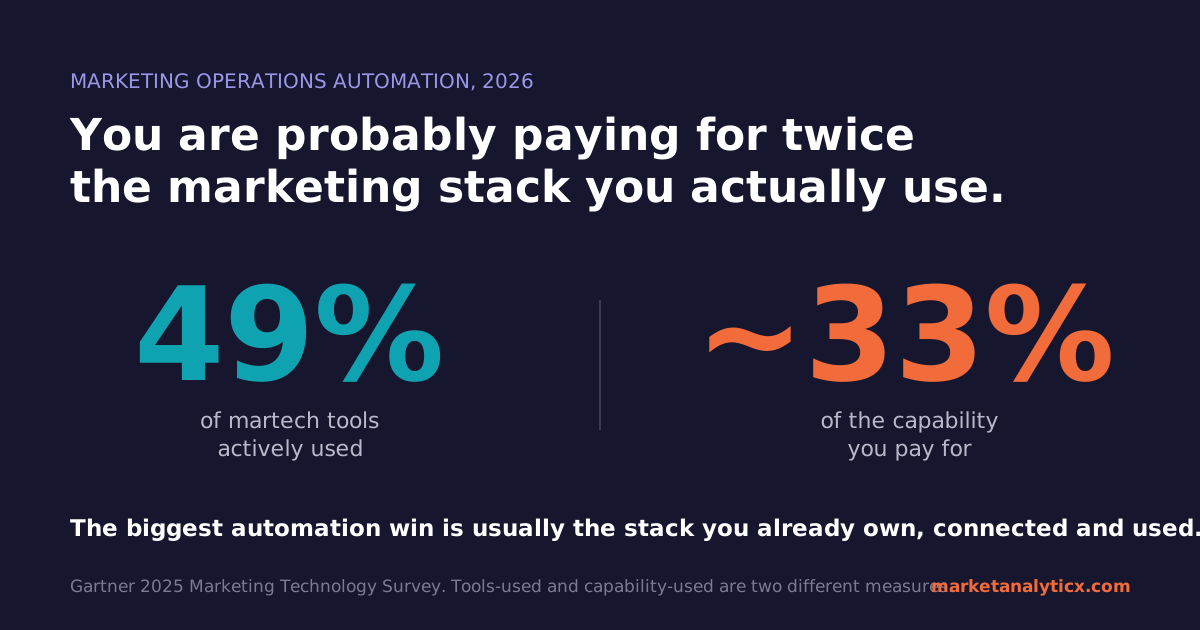
Here is the number that explains why this matters right now. Gartner’s 2025 Marketing Technology Survey found that marketing teams actively use just 49% of the tools in their stack, and by purchased capability the figure is closer to a third. Most teams are not short on software. They are short on a layer that makes the software they already bought actually work together.
Operations, automation, and the two-thirds you already pay for
The confusion between operations and automation is not academic. It leads teams to buy another tool when the problem is that the tools they own do not talk to each other.
A comparison helps. On its own, an automation platform is just capability sitting there, only as useful as the process and the person directing it. Operations is the part that decides what to automate, in what order, and with what guardrails, then documents it so it holds up when the team changes. You can have automation without operations, and you will end up with an expensive platform and a frustrated team using it without a system. You can have operations without automation, and you will have clean process but no ability to execute at scale. Marketing operations automation is deliberately pairing the two.
That pairing is where the wasted-spend problem gets solved. The average enterprise now runs roughly 91 martech tools, pulled from a market that now lists more than 15,000 of them. Utilization has slid for years: Gartner’s surveys put active use at 49% of tools in 2025, up from a low but still a fraction of what teams pay for, and by capability closer to 33%, down from 58% in 2020. Only about 15% of organizations qualify as martech high performers. Which points somewhere uncomfortable: for most teams, the biggest automation opportunity is not a new purchase. It is connecting and actually using the stack they already committed budget to.
There is good evidence that leaner beats bigger. Forrester’s 2025 B2B benchmark found companies running five or fewer core tools reported 23% higher marketing-attributed pipeline per headcount than those running ten or more. Data integration, meanwhile, is the single most-cited stack-management challenge, named by roughly two-thirds of organizations. Fewer tools, better connected, run by a real operations layer: that combination is what actually moves pipeline.
What actually gets automated
Marketing operations automation is not one feature. It is a set of repetitive jobs, each of which can be handed to software once the process behind it is clear.
Lead management. Scoring leads against demographic and behavioral signals, then routing them to the right salesperson the moment they cross a threshold. This is the classic handoff, and getting it right requires tight coordination with sales operations.
Data hygiene and syncing. Keeping records consistent across the CRM, the automation platform, analytics, and the warehouse. When systems fall out of sync, every downstream report inherits the error, so this unglamorous work underpins everything else.
Audience segmentation. Building and maintaining the segments that campaigns target, updated automatically as customer behavior changes rather than rebuilt by hand each time.
Campaign execution and QA. Setting up triggers and workflows, then running the checks that catch a broken link or a misfiring workflow before it goes live, not after a customer complains.
Reporting and dashboards. Replacing the manual monthly scramble of pulling numbers from eight tabs with automated dashboards that show campaign performance, funnel conversion, and pipeline contribution on a schedule.
The common thread is that automation removes manual effort from work that is rule-based and repetitive, and frees the team for the judgment-heavy work software cannot do: setting strategy, making the creative, and working out what the numbers actually mean.
What the ROI really looks like
The efficiency case for automation is strong and also frequently oversold, so the reliable claims are worth separating from the marketing.
The consistent, credible finding is time. Multiple studies put the savings at six or more hours per week on routine tasks like reporting and scheduled sends, which compounds into hundreds of recovered hours a year per person. Sales productivity gains of around 14.5% and overhead reductions near 12% show up across several sources. On returns, a widely cited Forrester Wave benchmark puts the average at roughly $5.44 back per dollar spent, with top-quartile programs closer to $8.71, and a frequently repeated figure holds that about 76% of companies see positive ROI within a year.
Now the honest caveat, because it matters more than any single number. Those ROI figures often rest on weak attribution. Automated email sequences, for instance, reliably beat manual sends on open and click rates, but beating a manual campaign and generating genuinely incremental revenue are not the same thing, and few of the headline studies test against a proper control group. Treat the direction as trustworthy and the exact multiples as marketing. The real, bankable return in the first year is usually time and consistency; the revenue lift is real too, but it is harder to prove than the case studies imply, and it depends entirely on whether your measurement is any good.
Market-size figures deserve the same skepticism. Estimates vary widely depending on scope and source: commonly cited numbers put the global marketing automation market in the high single-digit billions of dollars in 2026, growing at double-digit rates toward the mid-teens of billions by 2030. The precise number matters less than the direction, which every source agrees on.
Where to start, and how mature you actually are
Most teams are further from “automated” than they think. One 2026 analysis found that while a large majority of businesses use automation in some form, only about 9% run fully automated customer journeys; most are running partial automation with gaps between systems. The maturity gap, not the adoption gap, is where the value is now.
A sane order of operations for a mid-market team:
Audit before you automate. Map what you own, what you actually use, and where data breaks between systems. This is where the 49% utilization number becomes personal: you cannot automate a process you have not defined, and you should not pay to automate a tool you are about to cut. Start by finding the idle spend.
Automate the work closest to payback first. Reporting and lead routing usually return time fastest, because they are well-defined and run constantly. Prove the model on those before touching anything complex.
Fix the data layer. Automation built on inconsistent data just produces wrong answers faster. Clean, connected data is the dull, load-bearing foundation the rest of it stands on.
Then orchestrate across the journey. Once the fundamentals run reliably, connect them so a lead scoring high in the CRM triggers the right sequence, updates the right audiences, and shows up correctly in the forecast, without a human stitching each step together.
This is the loop we run for clients through the Signal Method at Market Analyticx: map the stack and the goal, connect the data, and automate the repetitive decisions so the team gets a reliable system instead of another dashboard. The principle underneath it is simple: make what you own work before you buy anything new.
The shift already underway: from automation to agents
The frontier of marketing operations automation in 2026 is the move from rule-based automation to AI agents that can carry out multi-step work, not just execute a fixed trigger. The distinction matters. Traditional automation follows an if-this-then-that rule you wrote in advance; an agent can plan and adjust across steps within the parameters you set.
The hype here is loud, so hold onto what the data actually says. Somewhere around 91% of marketers report using AI in their work in 2026, but fewer than a third are using it for genuinely autonomous, agentic work; the majority still operate it manually, like a faster tool. Gartner forecasts that 40% of enterprise applications will embed task-specific AI agents by the end of 2026, and that a meaningful share of routine work decisions will be made autonomously within a few years. But the same research found that 45% of martech leaders said the AI agents their vendors shipped failed to meet the performance they were promised. The technology is real and moving fast; the vendor promises are running ahead of the results.
The governance question is the one that will actually decide whether agents help or hurt. The emerging best practice keeps a human on the loop: agents draft, stage, and prepare work autonomously, but a person approves anything consequential before it goes live. The agent removes the manual effort; the human keeps control of what ships. For most mid-market teams heading into 2027, that is the responsible way to adopt this, and it is a natural extension of the same principle that governs all good marketing operations automation: automate the repetitive work, keep humans on the decisions that matter.
FAQ
Bottom line
Marketing operations automation is not about buying more software. It is about making the repetitive operational work of marketing run reliably, on a foundation of clean data and clear process, so your team spends its time on decisions rather than maintenance. The defining problem of 2026 is not a shortage of tools; it is that most teams actively use only about half the ones they already own.
The teams that win the next few years will be the ones that treat this as an operations discipline, not a shopping list: audit before they automate, connect what they have before they buy more, and adopt AI agents with a human kept firmly on the loop. Getting that system to run, and tying it to pipeline instead of vanity metrics, is the work we do at Market Analyticx.
Key takeaways
- Marketing operations automation automates the repetitive operational work of marketing (lead routing, data syncing, segmentation, QA, reporting), distinct from marketing automation, which is one tool it uses.
- The core 2026 problem is waste, not scarcity: teams actively use about 49% of their martech tools and closer to a third of the capability they pay for, per Gartner.
- Leaner stacks win: companies with five or fewer core tools reported 23% higher pipeline per headcount than those with ten or more.
- ROI is real but oversold: time savings and consistency are the reliable first-year returns; revenue claims often rest on weak attribution, so measure against control groups.
- The frontier is agentic AI, but adoption is early and vendor results are mixed; the safe pattern is agents that draft and stage, with a human approving what ships.
Ajendra Singh Thakur is a seasoned SEO Director and digital marketing strategist with over 11 years of experience scaling digital products and crafting impactful content for global brands. Specializing in AI-driven content creation and technical SEO, he has worked across eCommerce, Travel, Healthcare, and Recruitment industries. His work blends strategic marketing insight with search-optimized storytelling to boost traffic, rankings, and conversions. Currently, he leads growth at Index.dev and has previously driven 200x traffic growth at Turing, a Silicon Valley unicorn.